Year : 2026

Duration : 04 Months

Corporate Prepaid Program Management Interfaces CX Redesign

Role

Product Designer

Domain

FinTech

-Problem Statement

Problem Statement

Mastercard's corporate prepaid ecosystem had evolved into a fragmented experience that no longer met modern user and business needs. It needs a unified, scalable, and user-centric platform experience.

Mastercard's corporate prepaid ecosystem had evolved into a fragmented experience that no longer met modern user and business needs. It needs a unified, scalable, and user-centric platform experience.

Key Challenges

  1. Disconnected user journeys across products and platforms

  1. Complex onboarding flows that increased user friction

  1. Limited self-service capabilities, leading to greater support dependency

  1. Scalability constraints for white-label implementations

  1. Insufficient accessibility and localization support for global markets

The challenge

Corporate prepaid platforms lacked the modern capabilities and seamless experiences offered by competitors. The ecosystem was fragmented and inconsistent, resulting in a poor user experience, complex onboarding journeys, and limited self-service functionality. Additionally, the platform faced scalability challenges for white-label implementations and did not adequately support accessibility and localization requirements.

Corporate prepaid platforms lacked the modern capabilities and seamless experiences offered by competitors. The ecosystem was fragmented and inconsistent, resulting in a poor user experience, complex onboarding journeys, and limited self-service functionality. Additionally, the platform faced scalability challenges for white-label implementations and did not adequately support accessibility and localization requirements.

The approach

To address these challenges, we adopted a user-centered, research-driven approach. We began with stakeholder workshops and user research to define personas and map critical user journeys. Using these insights, we developed a unified cross-platform UX strategy to create consistency across mobile, web, and admin experiences. We also conducted a detailed competitor analysis to evaluate feature patterns, identify parity capabilities, and uncover differentiating features that could strengthen the product experience. Finally, we validated the designs through usability testing and accessibility reviews, delivering high-fidelity, implementation-ready solutions aligned with global standards.

To address these challenges, we adopted a user-centered, research-driven approach. We began with stakeholder workshops and user research to define personas and map critical user journeys. Using these insights, we developed a unified cross-platform UX strategy to create consistency across mobile, web, and admin experiences. We also conducted a detailed competitor analysis to evaluate feature patterns, identify parity capabilities, and uncover differentiating features that could strengthen the product experience. Finally, we validated the designs through usability testing and accessibility reviews, delivering high-fidelity, implementation-ready solutions aligned with global standards.

Design Activities

Design Activities

To transform the fragmented experience into a cohesive and scalable solution, we conducted the following design activities to understand user needs, align stakeholder goals, and guide the design process.

To transform the fragmented experience into a cohesive and scalable solution, we conducted the following design activities to understand user needs, align stakeholder goals, and guide the design process.

Conducted UX research, personas, and journey mapping for key users

Designed end-to-end experiences across mobile, web, and admin platforms

Created high-fidelity UI and prototypes in Figma (Design System aligned)

Conducted usability testing and accessibility validation

Business Context

Business Context

Corporate Cash Passport, powered by MPMS, operates in an increasingly competitive prepaid landscape disrupted by fintech leaders like Revolut, Wise, and Airwallex. While strong in backend capabilities, the platform lagged in user experience, self-service, and real-time visibility. This project focused on reimagining the end-to-end experience across app, web, and admin portal to improve usability, drive adoption, and strengthen Mastercard’s competitive position.

Corporate Cash Passport, powered by MPMS, operates in an increasingly competitive prepaid landscape disrupted by fintech leaders like Revolut, Wise, and Airwallex. While strong in backend capabilities, the platform lagged in user experience, self-service, and real-time visibility. This project focused on reimagining the end-to-end experience across app, web, and admin portal to improve usability, drive adoption, and strengthen Mastercard’s competitive position.

For this project, we identified two primary user groups: Finance Admins and Cardholders.

For this project, we identified two primary user groups: Finance Admins and Cardholders.

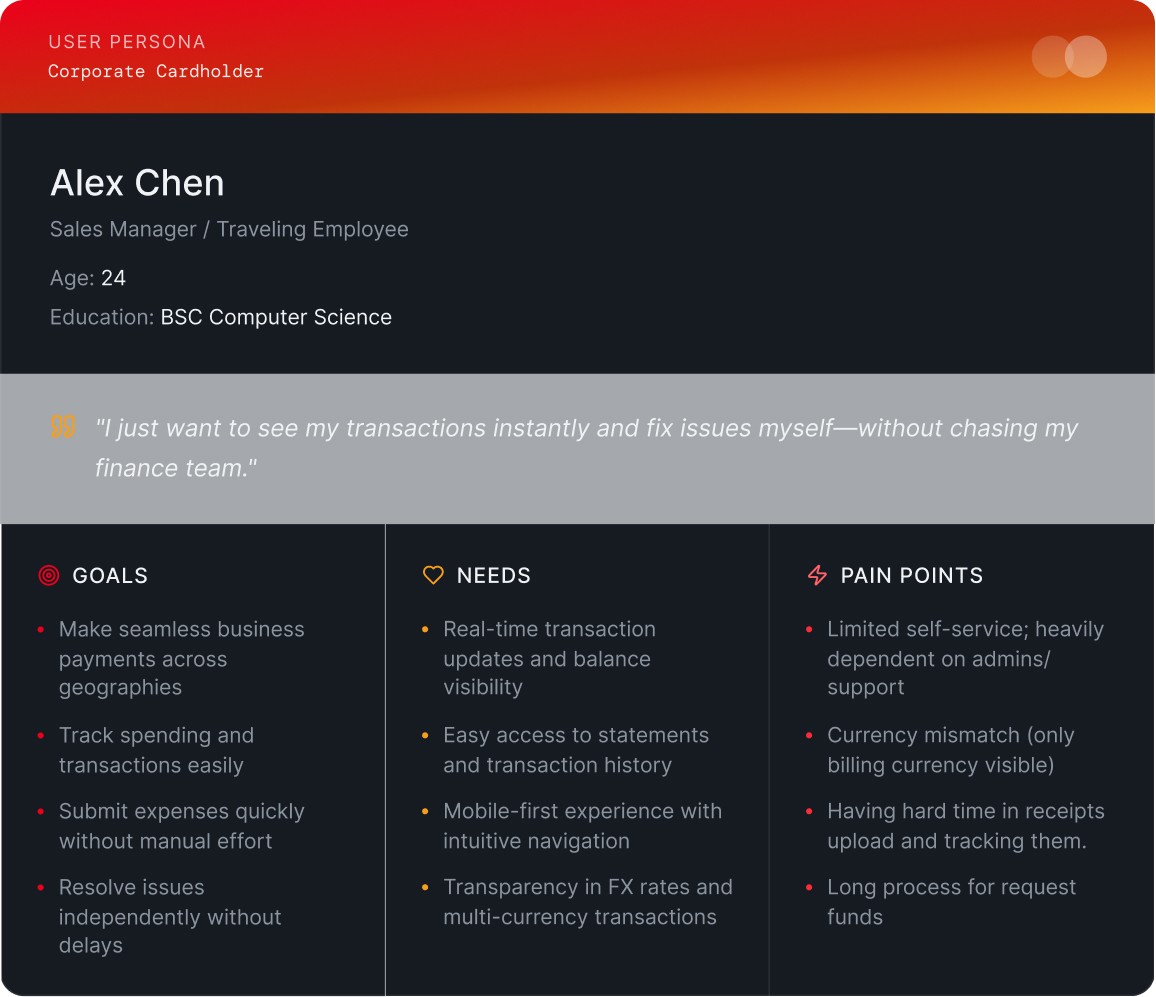
Within the Cardholder segment, we further uncovered three distinct user categories based on usage context.

Within the Cardholder segment, we further uncovered three distinct user categories based on usage context.

Each of these categories had different expectations, particularly around transaction visibility, controls, and usage patterns.

Each of these categories had different expectations, particularly around transaction visibility, controls, and usage patterns.

Expense
Cardholders

  • Subject to strict controls on where and how much they can spend

  • Mandatory receipt uploads for tracking, validation, and compliance

  • Use cards for business-related expenses and reimbursements

Per-diem
Cardholders

  • Manage daily travel allowances within predefined budgets

  • No need to upload receipts, as usage is pre-approved

  • Manage daily travel allowances within predefined budgets

Compensation
Cardholders

  • Receive payments such as reimbursements

  • No spending restrictions – can use funds freely

  • No requirement to upload receipts

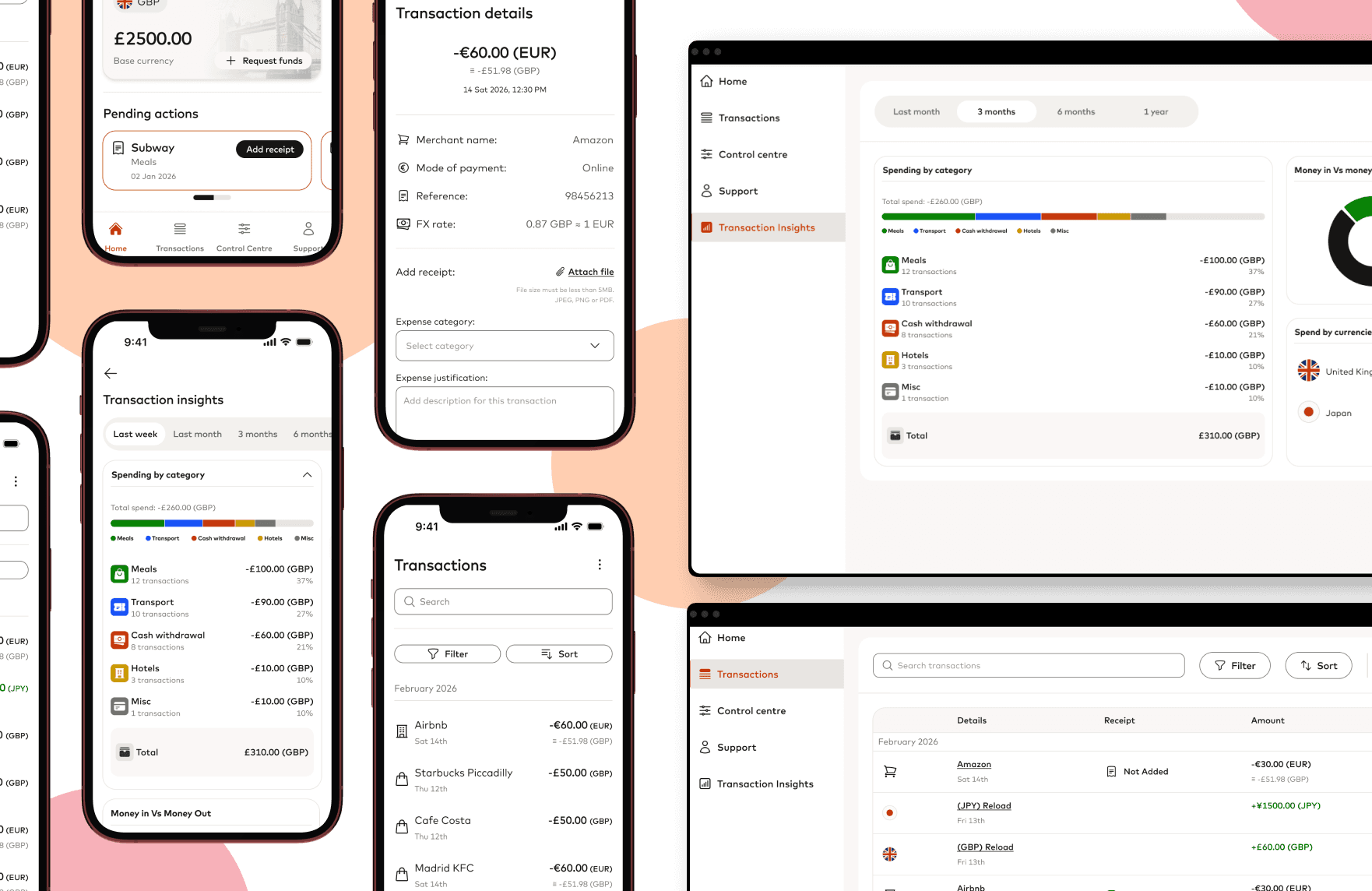
As a result, instead of a one-size-fits-all approach, we designed context-specific experiences and screen variations tailored to each cardholder type—ensuring the product could better support their unique needs while maintaining a consistent overall system.

As a result, instead of a one-size-fits-all approach, we designed context-specific experiences and screen variations tailored to each cardholder type—ensuring the product could better support their unique needs while maintaining a consistent overall system.

  1. Discovery & Alignment

  1. Discovery & Alignment

Mastercard's corporate prepaid ecosystem had evolved into a fragmented experience that no longer met modern user and business needs. It needs a unified, scalable, and user-centric platform experience.

Mastercard's corporate prepaid ecosystem had evolved into a fragmented experience that no longer met modern user and business needs. It needs a unified, scalable, and user-centric platform experience.

  1. Competitive Benchmarking

  1. Competitive Benchmarking

Conducted a competitive analysis of leading prepaid and fintech platforms to identify feature parity gaps, understand market expectations, and uncover opportunities to differentiate the Mastercard experience.

Conducted a competitive analysis of leading prepaid and fintech platforms to identify feature parity gaps, understand market expectations, and uncover opportunities to differentiate the Mastercard experience.

  1. User-Centered Design

  1. User-Centered Design

Defined key user personas and mapped cardholder and admin journeys to identify pain points, understand user behaviors, and uncover opportunities to simplify complex workflows and improve the end-to-end experience.

Defined key user personas and mapped cardholder and admin journeys to identify pain points, understand user behaviors, and uncover opportunities to simplify complex workflows and improve the end-to-end experience.

  1. Unified UX Strategy

  1. Unified UX Strategy

Designed a scalable and consistent cross-platform experience across mobile, web, and admin interfaces, ensuring seamless interactions and a unified user journey regardless of platform or user role.

Designed a scalable and consistent cross-platform experience across mobile, web, and admin interfaces, ensuring seamless interactions and a unified user journey regardless of platform or user role.

  1. Design Execution

  1. Design Execution

Designed and delivered high-fidelity user experiences and interactive prototypes, leveraging the Mastercard Design System to ensure consistency, accessibility, and scalability across white-label implementations.

Designed and delivered high-fidelity user experiences and interactive prototypes, leveraging the Mastercard Design System to ensure consistency, accessibility, and scalability across white-label implementations.

  1. Validation & Refinement

  1. Validation & Refinement

Designed a scalable and consistent cross-platform experience across mobile, web, and admin interfaces, ensuring seamless interactions and a unified user journey regardless of platform or user role.

Designed a scalable and consistent cross-platform experience across mobile, web, and admin interfaces, ensuring seamless interactions and a unified user journey regardless of platform or user role.

Information Architecture

Information Architecture

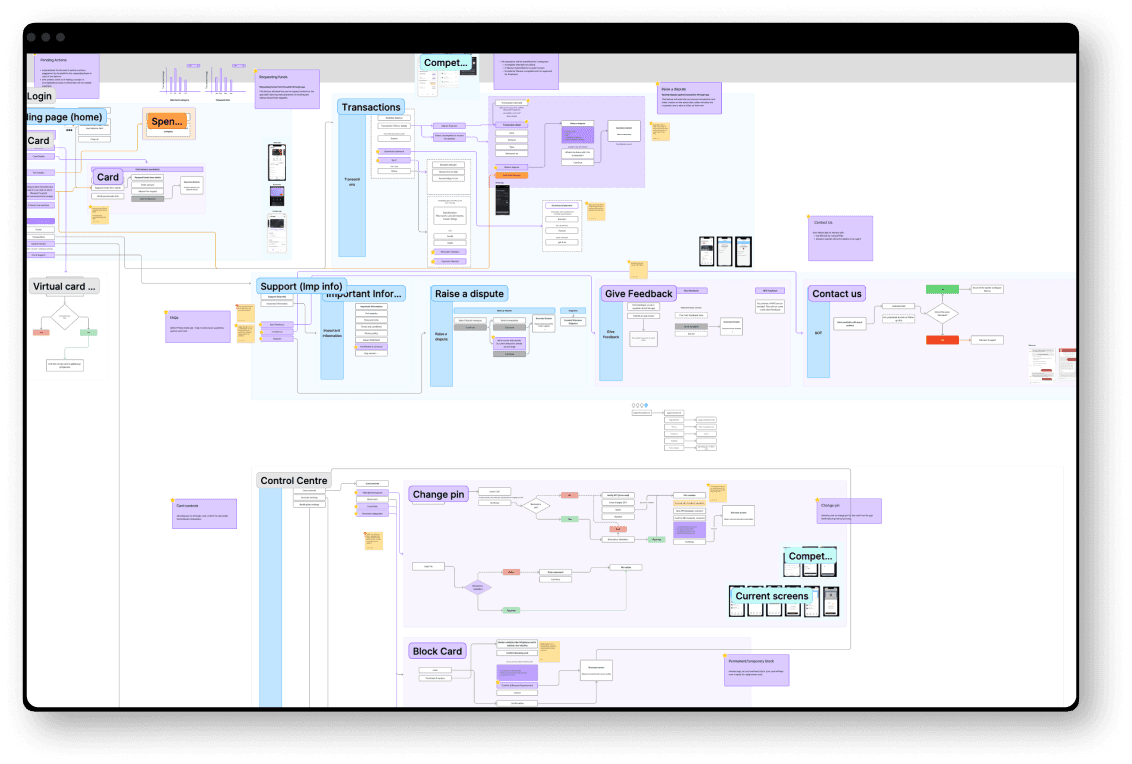
To define the information architecture, we first mapped the existing application to understand its structure, content, and navigation patterns. We then conducted a competitive analysis to identify industry best practices and compile a comprehensive feature list. These insights helped us create a scalable information architecture that organized features intuitively and supported a seamless user experience.

To define the information architecture, we first mapped the existing application to understand its structure, content, and navigation patterns. We then conducted a competitive analysis to identify industry best practices and compile a comprehensive feature list. These insights helped us create a scalable information architecture that organized features intuitively and supported a seamless user experience.

Final Design

Final Design

We designed a modular experience that accommodated the unique requirements of three user groups while leveraging shared patterns and components. This enabled a consistent experience across the platform and streamlined both design and development efforts. here is how homepage looks like -

We designed a modular experience that accommodated the unique requirements of three user groups while leveraging shared patterns and components. This enabled a consistent experience across the platform and streamlined both design and development efforts. here is how homepage looks like -

Transaction Pages

Transaction Pages

Other Pages

Other Pages

Business Impact

The transformation enabled a digital-first, self-service experience that improved customer engagement, reduced operational effort, and streamlined enterprise workflows through automation and centralized management.


·      35–50% reduction in manual processing effort
·      25–35% faster approval and request turnaround times
·      2–3× increase in admin productivity

Key Learnings

Designing for multiple user types reinforced the importance of creating flexible, reusable patterns that balance customization with consistency.

Leveraging an established design system accelerated delivery while maintaining consistency, accessibility, and scalability across platforms.

Building for white-label implementations highlighted the value of designing modular experiences that can adapt to different client requirements without compromising usability.

Thanks for the read.